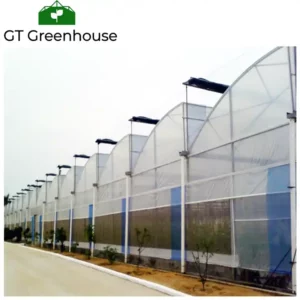
GT Aquaponics Growing Systems Solar Panels Greenhouse Commercial Aquaculture Greenhouse for Fish
Greenhouses work by converting light energy into heat. When the sun’s rays enter the greenhouse through plastic or glass panels, the frames absorb the heat, warming the air inside the building. The walls and roof of the greenhouse will absorb the heat, keeping the air inside stable. When the temperature gets too high, windows, vents, or fans in the greenhouse help release the hot air. Some greenhouses also come with separate heating systems that help increase the temperature when there’s not enough sunlight, such as during the winter.
Inquire Now
Product Description
China Greenhouse equipment supplier Commercial Aquaponics Greenhouse combines protected plant cultivation with aquaculture to create an integrated fish and plant production environment. The greenhouse can accommodate fish tanks, water circulation, filtration, plant growing systems and climate-control equipment within one protected growing facility.
Solar panels can also be incorporated into the overall project as an optional power source for selected greenhouse and aquaculture equipment. The final configuration can be customized according to fish species, crops, greenhouse dimensions, climate and production capacity.
Key Features of the Commercial Aquaponics Greenhouse
Integrated Fish and Plant Production
Aquaponics combines aquaculture and hydroponic plant cultivation in a connected water-management system. Fish are raised in tanks while nutrient-containing water is treated and supplied to the plant growing area.
Plants absorb nutrients from the water, while treated water can be returned to the aquaculture system. Proper filtration, oxygenation, water quality management and flow control are essential to maintaining the system.
Greenhouse Protection for Aquaponics
The Greenhouse equipment provides a controlled environment for both plant cultivation and supporting aquaculture equipment. Covering materials, ventilation, shading and climate-control systems can be selected according to local environmental conditions.
Solar Panel Integration
Solar panels can be integrated into the project to supply electricity for selected loads such as pumps, aeration equipment, sensors, controllers and other greenhouse systems.
The solar power system should be sized according to the actual electrical loads, operating hours, local solar conditions and whether battery storage or grid connection is required.
Custom Aquaponics Growing System
The aquaponics greenhouse can be configured with different fish tanks, plant growing areas, filtration systems, pumps and irrigation layouts. Greenhouse dimensions and equipment can be designed around the required production scale.
Commercial Aquaponics Greenhouse Specifications
| Item | Specification |
|---|---|
| Product Type | Commercial Aquaponics Greenhouse |
| Growing System | Aquaponics |
| Aquaculture | Fish Farming |
| Plant Growing | Hydroponic / Soilless Growing |
| Greenhouse Structure | Customized |
| Fish Tanks | Customized |
| Water Circulation | Pump-Based Recirculation |
| Filtration | Customized |
| Aeration | Optional |
| Plant Growing System | Customized |
| Solar Panels | Optional |
| Climate Control | Optional |
| Irrigation | Customized |
| Control System | Manual or Automatic |
| Application | Commercial Fish and Plant Production |
How Does a Greenhouse Aquaponics System Work?
An aquaponics system connects fish production with plant cultivation through water circulation.
Fish are raised in an aquaculture tank. Water containing fish waste is transferred through appropriate filtration and biological treatment processes before being supplied to the plant growing system. Plants take up available nutrients from the water, while the treated water can be circulated back toward the fish tanks.
The actual water-treatment sequence depends on the aquaponics system design, fish species, plant species, stocking density and production capacity.
Product Image


Fish Farming Greenhouse
The greenhouse can provide a protected environment for aquaculture facilities while also supporting year-round or seasonal plant production.
Fish tanks, filtration equipment, aeration, pumps and monitoring equipment should be selected according to the biological requirements of the target fish species. Water temperature, dissolved oxygen, pH, ammonia and other water-quality parameters should be monitored as required.
You can choose the covering material

Aquaponics Plant Growing System
The plant production area can use different growing configurations depending on the crop and project requirements, including:
- NFT hydroponic channels
- Ebb and flow growing beds
- Deep water culture
- Grow beds
- Planting trays
- Soilless growing systems
The appropriate growing method depends on crop type, root structure, water flow requirements and available production space.

Solar Power for Aquaponics Greenhouses
Solar panels can provide electricity for selected aquaponics and greenhouse loads, including:
- Water circulation pumps
- Aeration equipment
- Greenhouse ventilation
- Sensors and controllers
- Irrigation equipment
- Lighting systems
- Other auxiliary equipment
For off-grid or backup applications, battery storage and power-management equipment may also be considered. Solar capacity should be calculated from the complete electrical load rather than from greenhouse area alone.
Commercial Aquaponics Applications
The integrated system can be used for:
- Commercial fish farming
- Aquaponic vegetable production
- Leafy green cultivation
- Herb production
- Nursery production
- Educational aquaponics projects
- Research facilities
- Controlled-environment agriculture
- Integrated fish and plant farms